
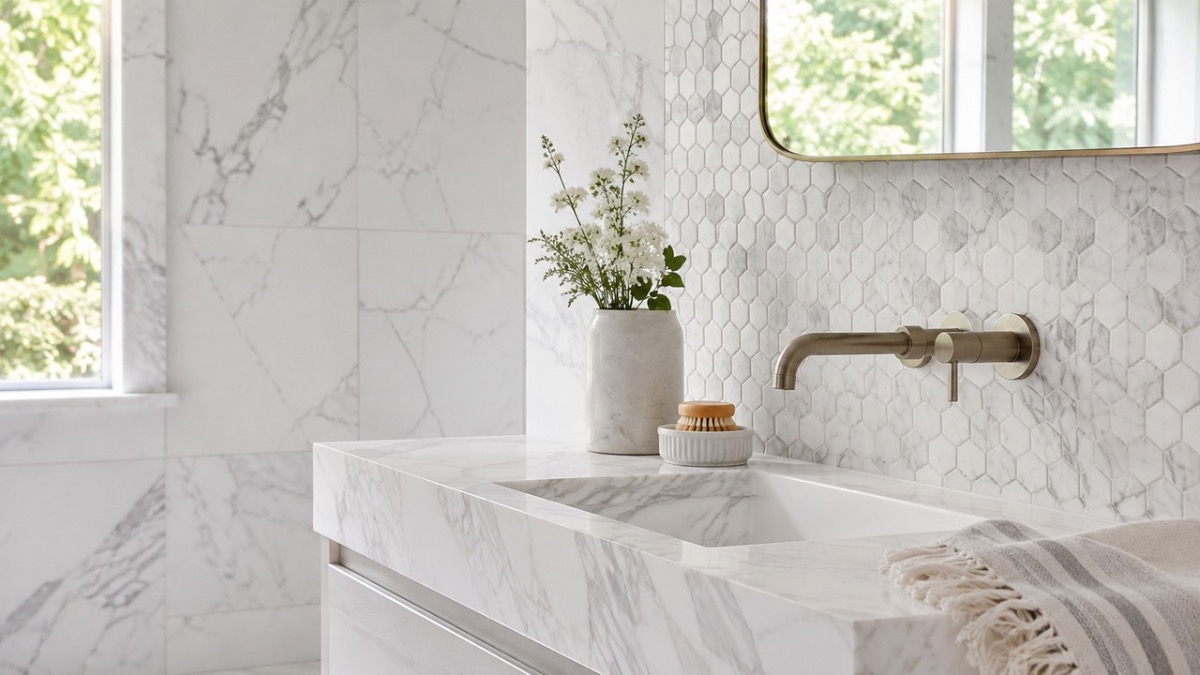
There is a moment in almost every renovation when practical decisions suddenly become emotional.
You have chosen the cabinets. The plumbing fixtures are ordered. The wall color has survived three rounds of debate. Then you place a piece of real marble against the wall and realize that the surface itself can completely change how the room feels.
That is where marble mosaic tile becomes interesting.
Unlike a flat printed pattern, natural marble has movement. Veins become darker, lighter, wider, or unexpectedly delicate. Two pieces from the same stone family can feel related without looking identical. For homeowners who want character rather than perfect repetition, that variation is often exactly the point.
Surfaces Galore specializes in natural stone and offers marble in tiles, mosaics, slabs, decorative pieces, and other formats. Its marble selection includes familiar stones such as Carrara, Calacatta, Nero Marquina, and other distinctive varieties, making it possible to approach a project from both a practical and decorative perspective.
But choosing marble successfully requires more than finding a pattern you like.
You need to think about scale, finish, room conditions, maintenance, installation, waste, grout, lighting, and something that online photographs can never reproduce perfectly: natural variation.
Let’s look at how to make those decisions without turning a beautiful idea into an expensive mistake.
Why Marble Mosaic Tile Still Feels Different
A good marble mosaic tile installation does something that large, uninterrupted surfaces cannot always achieve. It adds rhythm.
Small pieces create lines, repetitions, transitions, and shadows. A herringbone layout introduces movement. Basketweave feels architectural. Hexagons can push a room toward vintage, contemporary, or transitional styling depending on the stone and grout. Penny rounds soften hard surfaces, while geometric combinations can become the visual centerpiece of an otherwise restrained bathroom.
This versatility explains why mosaics work in so many different places.
They can become:
• a kitchen backsplash• a shower floor• a shower niche• a vanity wall• an entryway detail• a fireplace surround• a decorative border• a feature wall• part of a checkerboard or mixed-stone composition
Surfaces Galore, for example, lists marble mosaics intended for decorative patterns, backsplashes, shower walls, and accent applications, alongside standard marble tiles and larger stone formats. Its collection includes designs such as basketweave, lattice, herringbone, penny-round, hexagon, and woven patterns.
That variety matters because pattern changes more than appearance.
It changes the scale of the room.
A dramatic slab or large tile asks you to notice the stone itself. A mosaic asks you to notice both the marble and the pattern.
Natural Marble Is Beautiful Because It Is Not Perfect
One of the biggest mistakes people make when looking for marble tile for sale is expecting every tile to resemble the product photograph exactly.
Natural marble does not work like that.
Veining may become stronger from one piece to another. White backgrounds can shift warmer or cooler. Some pieces may appear quiet; others may contain dramatic mineral movement. Even marble sold under the same stone name can show noticeable variation.
Surfaces Galore specifically recommends evaluating samples because natural stone can vary in background color, veining density, and visual movement. A sample will not predict every individual tile in a shipment, but it can help confirm whether the general stone, quality and finish suit the project.
That difference should not automatically be treated as a problem.
In many interiors, it is what makes marble convincing.
Imagine a 70-square-foot bathroom covered in perfectly identical gray veining. It may look clean, but it can also begin to resemble a printed imitation. Now imagine the same room with subtle variation between individual pieces of marble mosaic tile.
Some veins disappear.
Others cross several small pieces.
A few darker areas create contrast.
Suddenly the floor has depth.
The irregularity becomes part of the design.
Carrara, Calacatta, Dark Marble or Something Warmer?
Choosing a marble family is usually the first major aesthetic decision.
Carrara for a Softer Interior
Carrara is often associated with a more restrained white-and-gray appearance. It works particularly well when you want marble to contribute texture without dominating every other surface.
A Carrara marble mosaic tile can make sense in a bathroom with white cabinetry, brushed metal hardware, warm wood, or muted wall colors.
It is also flexible.
A simple 2x2 mosaic feels very different from Carrara arranged in a lattice or woven composition.
Calacatta for More Drama
Calacatta tends to be chosen when stronger veining and a more expressive appearance are desirable. Surfaces Galore describes Calacatta as visually stronger than softer Carrara varieties and offers decorative Calacatta mosaics alongside standard tile formats.
This makes it particularly effective in smaller areas where the stone can become a focal point.
Consider a relatively simple bathroom:
White freestanding bathtub.Warm oak vanity.Neutral walls.Minimal brass fixtures.
Now add a Calacatta marble mosaic tile behind the vanity.
Nothing else has to compete with it.
Nero Marquina for Contrast
White marble is not the only answer.
Dark marble such as Nero Marquina can create a much sharper, more graphic interior. Used across an entire room it may feel intense, but as a border, backsplash, checkerboard element, or decorative contrast it can be remarkably effective.
This is especially useful when the design already contains black metal, darker cabinetry, or strong architectural lines.
The Finish Changes More Than You Think
Two pieces of identical marble can produce surprisingly different interiors simply because one is polished and the other is honed.
Surfaces Galore distinguishes polished, honed, tumbled, and brushed finishes. Polished marble reflects more light and emphasizes veining, while honed marble has a lower-sheen surface. Tumbled finishes intentionally introduce a softer, aged appearance, and brushed finishes add more surface texture.
Polished Marble
Polished stone creates stronger reflections.
Color looks richer. Veining often appears more pronounced. A polished marble mosaic tile can therefore work beautifully on backsplashes, shower walls, vanity walls, and decorative surfaces where visual impact matters.
But there is a compromise.
High sheen can reveal residue, etching, water marks, or wear more readily in certain conditions. On wet floors, traction also needs greater consideration.
Beauty does not eliminate practicality.
Honed Marble
Honed marble has a quieter character.
It does not bounce light around the room in the same way, and this can make an interior feel calmer and more architectural.
For many bathrooms, a honed marble mosaic tile is worth considering because the smaller pieces already create visual movement through grout lines and pattern. The surface does not necessarily need additional gloss.
The result can feel sophisticated without being overly formal.
Tumbled Marble
Tumbled marble deliberately looks less precise.
Edges feel softer. Texture becomes part of the visual language.
It can be an excellent fit for Mediterranean interiors, rustic kitchens, traditional bathrooms, older properties, and rooms where perfectly sharp contemporary lines would feel out of place.
Brushed Marble
Brushed stone sits somewhere between restrained sophistication and obvious texture.
For a spa-style bathroom, mudroom, or warmer transitional interior, this can be an interesting compromise.
The important lesson?
Do not choose marble by color alone. Choose color, format and finish together.
A Practical Bathroom Example
Suppose you are renovating a primary bathroom.
The room measures roughly 9 by 10 feet. You want marble, but covering every surface in expensive patterned stone would push the project beyond budget.
This is where strategic use of marble mosaic tile works exceptionally well.
Instead of installing a decorative mosaic everywhere, you might use:
• larger honed Carrara tiles on the main bathroom floor• a smaller mosaic on the shower floor• rectangular Carrara on the shower walls• a decorative basketweave or herringbone inside the shower niche• matching marble trim around selected edges
The expensive pattern becomes an accent rather than the entire project.
That accomplishes two things.
First, it controls cost.
Second, it prevents the design from becoming visually exhausting.
More marble is not automatically better marble.
Sometimes 10 square feet of an exceptional marble mosaic tile creates more impact than 100 square feet of the same pattern.
“I love the mosaic, but I’m worried it will be too busy,” a homeowner might say.
The answer does not have to be choosing another material.
Use less of it.
That is often the stronger design decision.
What to Check When You Buy Marble Tiles Online
The ability to buy marble tiles online gives homeowners and designers access to materials that may never appear in a local showroom.
It also creates uncertainty.
The photograph looks beautiful—but what arrives at your house?
Before ordering, look beyond the hero image.
Request a Sample
This is one of the simplest ways to reduce risk.
Surfaces Galore recommends samples specifically because photographs cannot communicate every characteristic of natural marble. A physical sample allows you to compare the stone against cabinetry, paint, hardware and lighting while also judging the actual finish.
Move the sample around.
Seriously.
Put it beside the vanity in the morning.
Place it under artificial lighting at night.
Hold it vertically if it will be installed on a wall.
Set it horizontally if it will become flooring.
A white marble that appears cold under showroom lighting may look warmer next to cream cabinetry. Strong gray veining might disappear in daylight but become prominent beneath warmer bulbs.
A ten-minute examination can prevent a decision you would otherwise live with for years.
Understand What the Sample Cannot Tell You
A marble sample is useful, but it does not guarantee that every tile in your full order will have identical coloration or veining.
That would contradict the nature of the material.
When you buy marble tiles online, the goal should be understanding the overall character of the stone—not finding a sample and demanding 150 identical copies of it.
Do Not Forget Waste
Tile calculations should rarely stop at the exact measured square footage.
Cuts break.
Corners consume material.
Patterns require trimming.
An installer may discover a damaged piece.
And months later, replacing one tile from the exact same batch may be difficult.
For straightforward layouts, buyers often add roughly 10% to the measured requirement. More complicated diagonal layouts, herringbone patterns, unusual rooms, or designs requiring extensive selection may justify 15% or sometimes more.
For marble mosaic tile, discuss waste with the installer before ordering.
A professional tile setter can look at the actual room geometry and provide a much better estimate than a generic online calculator.
That conversation may save both money and frustration.
Dry-Lay the Stone Before Installation
This step deserves more attention.
Before marble is permanently installed, open multiple boxes and examine the material together.
Do not install one carton completely, move to the next carton, and hope the stone variation distributes itself perfectly.
Mix pieces.
Rotate sheets.
Place more active veining next to quieter areas.
If one mosaic sheet has noticeably darker pieces, decide whether that becomes an intentional feature or should be moved elsewhere.
Natural variation looks best when somebody actually composes it.
Think of the installer as arranging stone rather than simply attaching tiles.
This matters especially with marble mosaic tile, because numerous small pieces can amplify tonal differences across a larger area.
Grout Can Change the Entire Result
People can spend weeks choosing marble and five minutes choosing grout.
That is backwards.
The grout line becomes part of every mosaic pattern.
With pale marble, a closely matched light grout allows the individual pieces to blend into a continuous textured surface.
A contrasting grout makes geometry more obvious.
Neither approach is universally correct.
Imagine white hexagonal marble.
With soft white grout, the eye notices the natural stone first.
With gray grout, the eye notices hundreds of hexagons.
Same marble.
Different room.
Before installation, test the grout next to the actual marble mosaic tile. Do not rely entirely on the tiny color square printed on a bag or displayed on a screen.
When Marble Mosaic Tile Is Better Than Large Tile
Large marble formats and mosaics are not competitors. They solve different design problems.
Large tiles reduce grout lines and allow natural veining to remain visually uninterrupted. This can make them ideal for larger floors, elegant shower walls, and open spaces.
A marble mosaic tile, by contrast, becomes especially useful when:
• you want pattern rather than uninterrupted stone• the area contains curves or complicated geometry• you are designing a shower floor• a small backsplash needs stronger visual character• you want to mix contrasting marbles• an accent needs to feel intentionally different• the project uses historical or traditional references
The best projects often combine both.
Large stone creates calm.
Mosaic creates emphasis.
Finding Marble Tile for Sale Without Choosing on Price Alone
It is tempting to search for marble tile for sale, sort by price, and choose whichever natural stone looks closest to the inspiration photo.
That can work.
It can also go badly.
A meaningful comparison should consider:
Stone type – Are you comparing the same marble variety?
Finish – Polished and honed surfaces can behave and look differently.
Thickness and dimensions – Small dimensional differences can complicate installation.
Available trim – A beautiful field tile is less useful if you cannot finish exposed edges properly.
Stock depth – Is there enough material from the same general batch for the project?
Samples – Can you inspect the actual stone beforehand?
Packaging and delivery – Natural stone is heavy and vulnerable to damage when poorly handled.
Replacement availability – What happens if additional material is required?
Surfaces Galorepositions itself as a direct importer of natural marble and travertine and states that it sources stone internationally, including from Italy, Greece, Spain, and Turkey. Its range extends from conventional marble tiles to mosaics, pavers, slabs, trim pieces and custom-cut products.
So when evaluating marble tile for sale, look at the complete project rather than the square-foot price alone.
Cheap tile that creates three installation problems is no longer cheap.
Why Ordering Online Can Actually Improve the Design Process
There is an obvious disadvantage when you buy marble tiles online: you cannot immediately touch every product.
But there is also a benefit.
Selection becomes broader.
Instead of choosing among five marble options displayed by a local retailer, you can compare different stones, sizes, patterns and finishes systematically.
You might begin convinced that you want standard Carrara subway tile and eventually discover that a Carrara lattice marble mosaic tile gives the room much more personality.
Or perhaps you wanted dramatic Calacatta throughout the bathroom, only to realize from a sample that its movement competes with your vanity.
Changing direction before installation is inexpensive.
Changing direction afterward is painful.
Three Mistakes Worth Avoiding
Mistake 1: Designing From One Photograph
Pinterest, Instagram, magazines and product photography provide inspiration, not construction documents.
Room size matters.
Lighting matters.
The surrounding materials matter.
That spectacular black-and-white marble mosaic tileseen in a huge Manhattan entry hall may overpower a narrow four-foot powder room.
Borrow the idea.
Do not blindly copy the room.
Mistake 2: Expecting Uniform Natural Stone
If perfectly identical coloration is your highest priority, natural marble may not be the easiest material for the project.
That does not make marble inferior.
It means the product has a different visual logic.
Variation is part of it.
Accepting that before purchase prevents unnecessary disappointment afterward.
Mistake 3: Ordering Exactly Enough Material
Imagine completing 98% of a bathroom and discovering that four additional mosaic sheets are required.
The original batch is gone.
The replacement material has noticeably different veining.
Now a small saving made during ordering has created a visible compromise in an expensive renovation.
Order thoughtfully, and keep some spare material after installation.
Marble Should Feel Intentional, Not Excessive
There is a tendency in luxury renovation to assume that adding more premium material automatically creates a better result.
It does not.
A beautiful marble mosaic tile is strongest when it has a reason to be there.
Maybe it defines the shower.
Maybe it frames the range in a kitchen.
Maybe it introduces a traditional basketweave pattern beneath a modern freestanding bathtub.
Maybe a small strip of Nero Marquina breaks up an otherwise white Carrara bathroom.
Good design is not about proving how much marble you could afford.
It is about deciding where the eye should stop.
Final Recommendation: Choose the Stone in the Context of the Room
Start with the room, not the product page.
Ask where the marble will be installed, how much water or traffic it will experience, what lighting it will receive, and whether you want the stone or the pattern to dominate.
Then narrow your choices.
If the room needs decorative movement, investigate marble mosaic tile options. If you need broad, calmer surfaces, consider larger marble formats and use mosaics selectively. Compare polished and honed finishes instead of assuming one is automatically better. Request a sample before committing to a large order. And when you buy marble tiles online, calculate enough material for cuts, waste and future repairs.
Most importantly, allow natural marble to look natural.
The quiet changes in color, unexpected veins and slight differences between individual pieces are not obstacles to overcome. They are the reason genuine stone continues to have a character that manufactured repetition struggles to imitate.
When chosen carefully, marble mosaic tile does more than cover a wall or floor.
It becomes one of the details people remember about the room.